


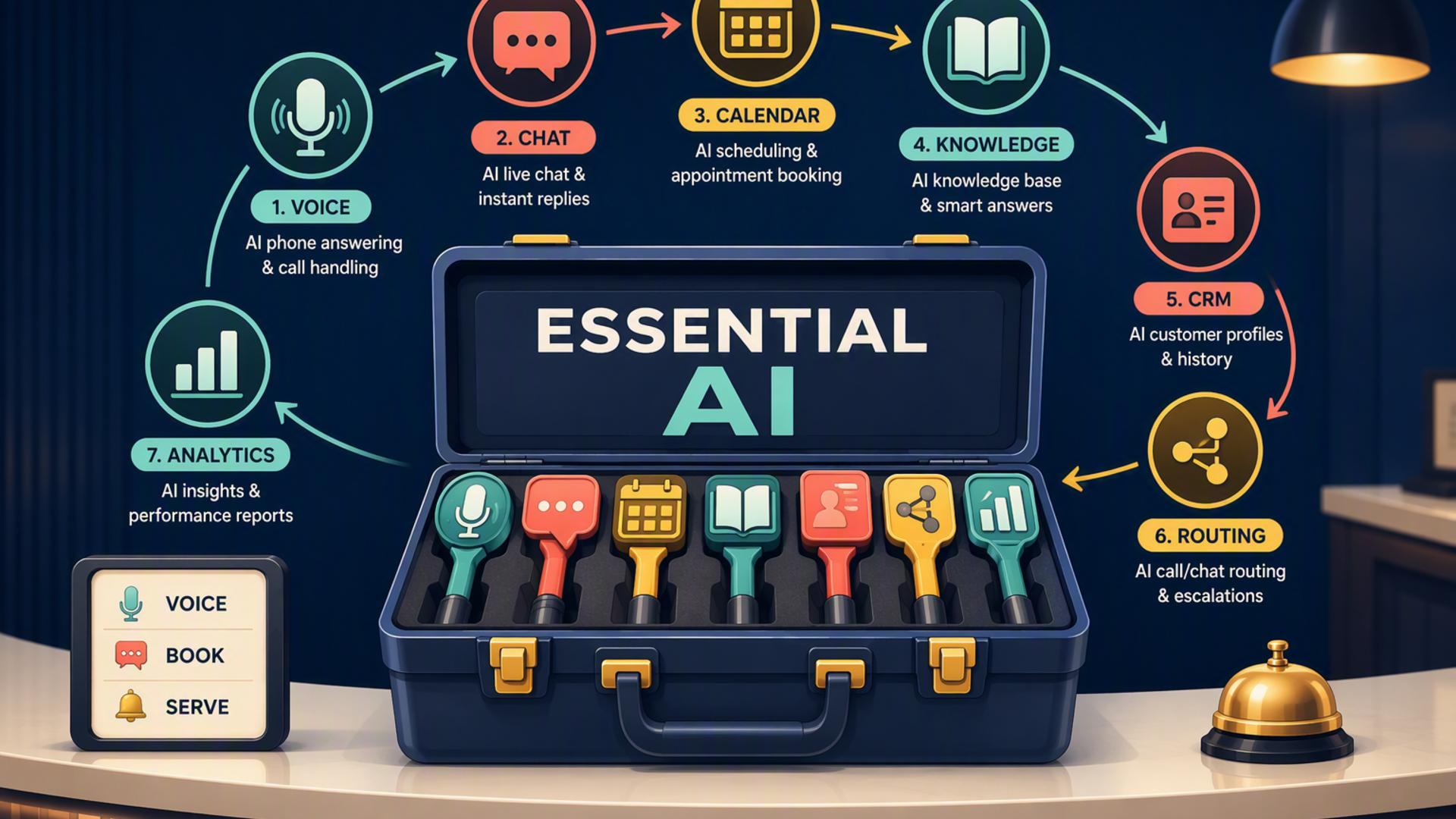
7 Essential AI Tools for Your 24/7 Front Desk
A modern front desk no longer has to be limited by business hours. With the right mix of AI, scheduling, customer management, communication, and automation tools, businesses can answer inquiries, capture leads, coordinate appointments, and organize follow-up even when no one is physically available to pick up the phone.
The most effective setup is not necessarily one large platform. It is often a connected technology stack in which each tool handles a specific part of the customer journey. From answering the initial call to scheduling the next conversation and routing information to the right employee, these seven tools can help businesses build a responsive 24/7 front desk.
1. DialMyCalls AI Receptionist
For businesses building an always-available front desk, DialMyCalls AI Receptionist provides the most natural starting point because it handles the interaction that often happens first: the phone call. Instead of directing after-hours or unanswered calls to voicemail, the AI receptionist can answer incoming calls, hold natural conversations, respond to common questions, capture caller information, and take messages around the clock.
Turn Every Incoming Call Into an Opportunity
A front desk is only useful if customers can actually reach it. DialMyCalls AI Receptionist can respond during regular hours, busy periods, evenings, weekends, and holidays. It can collect information such as the caller's name, phone number, reason for calling, appointment request, and other details needed for follow-up. This makes it particularly valuable for businesses where an unanswered phone call could mean a missed customer or lead.
Build the Rest of the Workflow Around the Call
Its real value becomes even clearer when DialMyCalls serves as the entry point to a broader workflow. Once the AI has gathered information from a caller, that information can move into the systems responsible for scheduling, customer management, support, or internal communication. DialMyCalls also supports scenarios where calls are forwarded to the AI receptionist during specific conditions, including after-hours periods and missed-call situations.
For a 24/7 front desk, this makes DialMyCalls AI Receptionist the strongest core tool on the list. Scheduling software can book meetings and CRMs can organize customer information, but neither replaces the initial conversation when someone calls the business. Starting with an AI receptionist creates the foundation, while the remaining tools can extend what happens after that first interaction.
2. Zapier
Once several front desk applications are in use, Zapier can help connect them into a more cohesive system. Rather than requiring employees to manually copy information between platforms, Zapier lets businesses create automated workflows based on triggers and actions. A particular event in one application can automatically initiate an action in another.
Connect Separate Front Desk Systems
For example, information generated from an inbound interaction could trigger another step elsewhere in the technology stack, depending on the integrations available. That might involve creating a record, updating a system, sending a notification, or initiating another business process. Zapier is designed specifically to connect applications and automate repetitive workflows.
Reduce Routine Administrative Work
The practical benefit is less manual data movement. When front desk information has to be transferred by hand from one platform to another, every additional step creates another opportunity for delays or omissions. Automation can keep those processes moving without requiring an employee to repeatedly perform the same administrative task.
Zapier is therefore best viewed as connective tissue rather than the front desk itself. It does not replace the AI answering calls, the CRM storing customer records, or the scheduler managing availability. Instead, it can help those specialized tools work together, which becomes increasingly important as a business adds more automation.
3. Freshdesk
Not every front desk interaction can be resolved immediately. When an inquiry needs follow-up, technical assistance, or attention from another department, Freshdesk gives businesses a structured way to turn customer issues into trackable support tickets. Its ticketing platform brings requests together and provides tools for assigning and monitoring them.
Turn Requests Into Trackable Tickets
Freshdesk supports tickets originating across channels including email, chat, and voice, helping teams centralize customer support rather than leaving requests scattered across separate inboxes or conversations. Tickets can be delegated and their progress tracked, giving employees a clearer view of unresolved customer needs.
Automate Support Workflows
Automation is another useful part of Freshdesk. The platform supports routing, categorization, and workflows for repetitive support tasks. Automation rules can also respond to events such as ticket creation and ticket updates, helping teams standardize how certain requests move through the support process.
Freshdesk makes particular sense for a front desk that receives substantial service or support traffic. DialMyCalls can handle the initial phone conversation, while a help desk platform gives more complex issues somewhere structured to go afterward. That division keeps the first interaction responsive without expecting the receptionist layer to perform the work of an entire support department.
4. Google Calendar
Google Calendar can provide the scheduling foundation behind a virtual front desk, especially for organizations already using Google Workspace. Beyond standard calendar management, Google offers appointment scheduling features that let businesses create booking pages and define when appointments are available.
Keep Availability Organized
Appointment schedules are designed to reflect calendar availability so customers or other contacts can choose suitable booking times. Confirmed appointments then appear on the associated Google Calendar automatically. This gives the business a centralized schedule while reducing the amount of manual coordination involved in finding an available time.
Support a Connected Booking Process
Within a broader front desk workflow, Google Calendar can act as the source of scheduling information. When a caller wants to arrange a consultation, demonstration, service appointment, or follow-up, calendar availability becomes an important part of completing the interaction instead of simply recording an appointment request.
Google Calendar works particularly well when a company already relies heavily on Google Workspace and wants scheduling to remain close to its existing calendars. It is not an AI receptionist or customer management platform on its own, but it can be a reliable scheduling component within a larger automated front desk.
5. Slack
Once an AI front desk has collected information, employees still need an efficient way to know what requires their attention. Slack can fill that internal communication role by giving teams dedicated spaces for messages, notifications, and workflows while integrating with other workplace applications.
Send Important Information to the Right Team
Instead of front desk information sitting unnoticed in a separate application, connected workflows can bring relevant updates into the channels employees already monitor. Slack supports third-party integrations, and its Workflow Builder can connect workflows with other applications to perform actions or automate routine processes.
Keep Internal Follow-Up Moving
This can be especially useful for high-priority situations. A new sales inquiry, an urgent service request, or another call requiring human attention can be surfaced to the relevant team so someone knows there is a next step. Slack's configurable channel and direct-message notifications also allow employees to control how different conversations attract their attention.
Slack does not manage customer calls or replace a CRM, which is precisely why it fits comfortably alongside those tools. Its job in the front desk stack is internal coordination. After an AI receptionist captures the information, Slack can help make sure the people responsible for acting on it remain connected.
6. Calendly or Acuity Scheduling
For businesses where the next logical step after an inquiry is an appointment, Calendly or Acuity Scheduling can add a more specialized booking layer. Both are designed to reduce the back-and-forth traditionally involved in finding a suitable meeting time and can work well alongside an AI-powered phone answering setup.
Give Customers Real-Time Scheduling Options
Calendly lets users define availability, create meeting types, share scheduling links, and automate elements such as meeting reminders and follow-ups. It can connect with calendars to help keep available booking times aligned with an individual's existing schedule.
Handle More Detailed Appointment Workflows
Acuity Scheduling provides another approach, with tools for managing availability across staff and locations, calendar syncing, automated email and text reminders, and payment processor integrations. Those capabilities can make it particularly useful for appointment-based businesses with more detailed booking requirements.
Either platform can complement an AI receptionist when booking is a frequent outcome of incoming calls. The receptionist handles the conversation and identifies what the caller needs, while the scheduling layer provides the infrastructure for turning that interest into a confirmed appointment.
7. HubSpot or Salesforce
Capturing a caller's information is valuable, but businesses also need somewhere to organize that relationship after the conversation. HubSpot or Salesforce can provide this CRM layer, helping companies store contact information, track leads, monitor interactions, and manage opportunities as they progress.
Keep Leads and Customer Information Organized
HubSpot's CRM includes tools for organizing customer data and managing leads, while its broader customer platform connects CRM information with sales, marketing, and service functionality. Lead management features can help teams maintain records and organize prospecting activity rather than relying on disconnected notes or spreadsheets.
Build More Advanced Sales Workflows
Salesforce also provides extensive lead and customer management capabilities. Its sales tools can capture and organize leads, manage follow-up, track opportunities, apply assignment rules, and support automation throughout the sales process. For organizations with more complex sales operations, these capabilities can provide a substantial system for managing what happens after a prospect first contacts the business.
The choice between HubSpot and Salesforce largely depends on the broader systems and processes a business wants to build around its customer data. Within a 24/7 front desk, however, their fundamental role is similar: the AI receptionist begins the conversation, while the CRM preserves the information needed to continue the relationship.
Creating a Front Desk That Never Really Closes
A successful 24/7 front desk works best when each tool has a clear role. DialMyCalls AI Receptionist provides the essential first layer by answering calls and capturing information even when employees are unavailable. From there, scheduling tools can turn conversations into appointments, CRMs can organize leads, Freshdesk can manage support requests, Slack can alert internal teams, Google Calendar can coordinate availability, and Zapier can connect the moving pieces. Together, these tools can create a front desk that remains responsive without requiring employees to manually oversee every step of every interaction.
Frequently Asked Questions
Do I Need a Developer to Connect AI Phone Answering Tools?
Usually, no. Many common integrations can be configured without writing custom code. Automation platforms such as Zapier use trigger-and-action workflows to connect supported applications, while platforms such as Calendly, HubSpot, and Slack offer integrations of their own. More specialized or highly customized workflows may still require technical assistance, but many businesses can build a practical front desk setup using existing integrations.
Which Tools Work Well With Virtual Receptionist Software?
Scheduling platforms, CRM systems, internal messaging applications, help desk software, calendars, and workflow automation tools can all complement a virtual receptionist. Each handles a different stage after the initial interaction, such as booking an appointment, storing a new lead, notifying an employee, or opening a support ticket. The goal is to create a connected process so information does not have to be repeatedly transferred by hand.
How Can AI Phone Answering Help Automate Lead Capture?
A useful approach is to connect the information collected during an AI-handled call with a CRM or lead management workflow. The receptionist can gather the caller's name, contact information, reason for calling, and other relevant details, while the connected CRM provides a structured place for the business to manage the lead afterward. DialMyCalls AI Receptionist is designed to capture caller details, while CRM platforms such as HubSpot and Salesforce provide dedicated lead management capabilities.
Adding scheduling to that workflow can take the process further. Rather than collecting an inquiry and waiting for an employee to arrange the next interaction later, scheduling software can provide the infrastructure needed to move an interested caller toward a booked appointment.
Is AI Receptionist Workflow Automation Hard to Set Up?
It does not necessarily have to be complicated. Many businesses can start with a small workflow involving only the systems they use most frequently, such as an AI receptionist, a scheduling platform, and a CRM. Automation platforms such as Zapier are specifically designed to connect applications through defined triggers and actions rather than requiring every integration to be custom developed.
The setup can then become more sophisticated over time. Once the basic call, scheduling, and lead-management process is working smoothly, a business can add support ticketing, team notifications, and additional automated actions as its needs grow.
